The Power of Gratitude: A Simple Habit That Increases Your Joy and Longevity
Gratitude is one of the most powerful habits we can develop to increase our joy, our harmony, and our sense of meaning. Yet gratitude is something many of us forget in the rush of everyday life. We run between meetings, deadlines, and obligations — and often miss the small moments that actually make life beautiful.
But research shows that gratitude doesn’t just make us happier. It makes us healthier. It makes us calmer. It makes us more resilient. And it can even contribute to a longer life.
One of the most well‑known studies in positive psychology shows that people who practice gratitude regularly experience more joy, less stress, better sleep, and improved physical health¹. It’s fascinating how something so simple can have such a profound effect.
Why do small rituals work so well?
Small rituals create safety. They create structure. They create a sense of control in a world that often feels unpredictable.
When you repeat a ritual — no matter how small — you send a message to your body:
You are safe. You are here. You can land.
Research shows that even short micro‑pauses during the day reduce stress and increase mental recovery².
It can be as simple as:
- starting your morning with three deep breaths
- drinking your tea slowly and mindfully writing down three things you’re grateful for
- ending your day with a short walk
- placing a hand on your heart and saying something kind to yourself
These small actions create moments of calm, and when you repeat them day after day, they begin to change how you feel — not just in the moment, but in your life.
Why does gratitude work so well?
When you practice gratitude, you direct your attention toward what is working, what is beautiful, and what brings you warmth. It doesn’t mean ignoring problems — it means giving your brain a chance to see the whole picture, not just what’s difficult.
Research shows that gratitude activates parts of the brain connected to wellbeing, calm, and social connection. It reduces stress hormones and increases levels of dopamine and serotonin — the body’s natural “feel‑good” chemicals.
When you feel gratitude, something shifts in your body:
- your heart rate slows your muscles relax
- your thoughts become clearer
- you feel more present
It’s as if gratitude creates an inner shield against life’s storms.
Gratitude in practice – small steps, big impact
Gratitude doesn’t have to be big or dramatic. It can be appreciating a message from a friend, a ray of sunlight on your way to work, a cup of coffee, or the feeling of slipping into clean sheets.
Here are a few simple ways to begin:
- Write down three things you’re grateful for each day
- Say “thank you” out loud — even when no one hears
- End your day by reflecting on something that went well
- Send a gratitude message to someone who means a lot to you
What matters is not what you’re grateful for
— what matters is that you feel it.
Gratitude, joy, and longevity
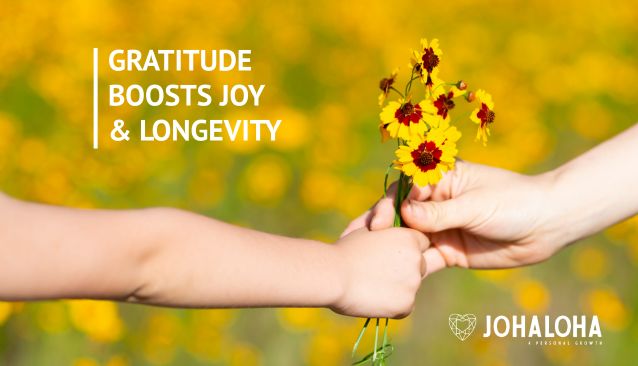
Gratitude is not just a feeling. It’s a habit. A lifestyle. A path to more joy, more love, and more harmony.
Studies show that people who live with more gratitude often have:
- stronger relationships
- better immune function
- lower risk of depression
- longer life expectancy
Gratitude transforms life — one moment at a time
When you begin to notice the small things, the big things grow. When you appreciate what you have, you create space for more. When you practice gratitude, you practice joy. And when you practice joy, you change your life.
Gratitude is one of the simplest paths to a happier, healthier, and longer life. And the best part? You can start today.
References
¹ Emmons, R. A., & McCullough, M. E. (2003). Counting Blessings Versus Burdens. https://pubmed.ncbi.nlm.nih.gov/12585811/
² Wood, A. M., Joseph, S., Lloyd, J., & Atkins, S. (2009). Gratitude influences sleep through the mechanism of pre‑sleep cognitions. Journal of Psychosomatic Research, 66(1), 43–48. https://doi.org/10.1016/j.jpsychores.2008.09.002